


STGAubron Gaming PC (i5-13400F / RTX 3050 6G) Technical Review: A 1080p Contender Analyzed
Introduction: Assessing a Modern Mid-Range Prebuilt
In the highly competitive market of prebuilt gaming PCs, finding a system that balances modern processing power, capable graphics, and essential features at an accessible price point is the primary goal for most consumers. The STGAubron Gaming PC enters this arena with a compelling specification sheet, headlined by a 13th-generation Intel Core i5 processor and an NVIDIA GeForce RTX 30-series graphics card. This configuration is aimed squarely at the 1080p gaming market, also known as the “sweet spot” where the vast majority of PC gamers reside.
This in-depth, technical review will dissect the components of this STGAubron build. We will analyze the performance capabilities of the Intel Core i5-13400F, conduct a critical examination of the specific GeForce RTX 3050 6G variant, and evaluate how the 16GB of DDR4 RAM and 512GB SSD support this hardware pairing. We will also assess its connectivity, thermal design, and overall suitability as a modern gaming, streaming, and productivity machine. This analysis is based entirely on the system’s technical specifications and their established performance benchmarks in the wider market.
The Processing Core: Intel Core i5-13400F
The foundation of this STGAubron Gaming PC is its processor: the Intel Core i5-13400F. This CPU is a standout performer from Intel’s 13th-generation “Raptor Lake” architecture, representing one of the most significant generational leaps in the Core i5 family’s history.
A Hybrid Architecture Powerhouse
Unlike older quad-core or 6-core designs, the i5-13400F utilizes Intel’s hybrid architecture. It combines two types of processing cores to optimize for both high-performance and background tasks:
- 6 Performance-cores (P-cores): These are the high-power cores, based on the “Raptor Cove” architecture. They handle the primary load of demanding applications, such as the game itself, and can reach a max turbo frequency of 4.6GHz. This high clock speed is critical for achieving high frame rates, as many games still rely heavily on strong single-core performance.
- 4 Efficient-cores (E-cores): These are smaller cores designed to handle multi-threaded workloads and background processes (like Discord, web browsers, or system services) with high efficiency.
This 10-core, 16-thread configuration (6 P-cores + 4 E-cores) makes the i5-13400F an exceptional multitasking processor. In a gaming scenario, the P-cores can be dedicated to the game, while the E-cores ensure that background tasks do not interrupt the gaming experience, leading to smoother, more consistent performance.
Performance Beyond Gaming
The “F” suffix in its name denotes that this CPU does not have an integrated graphics processor. In a gaming PC with a dedicated graphics card like the RTX 3050, this is an irrelevant distinction and often helps lower the component’s cost.
The true value of the i5-13400F is its versatility. For users who do more than just game, this processor is a productivity workhorse. It can easily handle:
- Content Creation: 1080p and even 1440p video editing, photo manipulation, and music production.
- Software Development: Compiling code and running virtual machines.
- CPU-Based Streaming (x264): While the RTX 3050’s NVENC encoder is the superior streaming choice, the 10-core i5-13400F has enough raw power to handle a high-quality x264 (CPU) encode for lighter games, offering valuable flexibility.
Pairing a CPU of this caliber in a budget-to-mid-range build provides a strong foundation and a significant degree of “future-proofing,” as this processor is unlikely to become a performance bottleneck for several years.
The Graphics Engine: A Critical Look at the GeForce RTX 3050 6G
The visual performance of this system is handled by the NVIDIA GeForce RTX 3050 6G. It is absolutely critical to distinguish this specific model from the original GeForce RTX 3050 8GB variant, as they are not the same product.
Ampere Architecture and Core Features
Based on NVIDIA’s “Ampere” architecture, the RTX 3050 6G brings several key technologies to the entry-level market:
- DLSS 2.0 (Deep Learning Super Sampling): This is arguably its most important feature. DLSS uses AI to render the game at a lower internal resolution and then intelligently upscales the image to the target resolution (e.g., 1080p). This results in a massive performance boost—often 30-50% or more—with minimal perceptible loss in visual quality. For a card in this performance tier, DLSS is the key to running demanding modern games at high settings.
- Ray Tracing (RT Cores): The card possesses 2nd-generation RT cores, allowing it to run games with ray-traced lighting, shadows, and reflections. However, the performance cost is high. Users should expect to use DLSS in “Performance” or “Ultra Performance” modes to achieve playable frame rates (30-60 FPS) with ray tracing enabled in most titles.
- NVENC Encoder: The 7th-generation NVIDIA Encoder (NVENC) is a dedicated media encoder on the GPU. This is a game-changer for aspiring streamers, as it allows the GPU to handle the entire video encoding load for a stream (via OBS, Streamlabs, etc.) with almost no impact on in-game frame rates.
The 6GB VRAM and 96-bit Bus: A Technical Compromise
The “6G” designation is the most important technical specification. Compared to the original 8GB model, this 6GB version features several significant cutbacks:
- VRAM: Reduced from 8GB to 6GB GDDR6.
- Memory Bus: Reduced from a 128-bit bus to a 96-bit bus.
- CUDA Cores: Reduced from 2,560 to 2,304 CUDA cores.
The 96-bit memory bus is the most significant performance limitation, as it reduces the card’s total memory bandwidth from 224 GB/s (on the 8GB model) to 168 GB/s.
Real-World 1080p Gaming Performance
What does this mean for the user? The GeForce RTX 3050 6G is a dedicated 1080p graphics card through and through.
- Esports Titles: In games like Valorant, Apex Legends, League of Legends, and Counter-Strike 2, this card will perform exceptionally well, capable of pushing high frame rates (144+ FPS) at 1080p on competitive settings, making it ideal for a high-refresh-rate monitor.
- AAA Titles: For modern, graphically demanding AAA games like Cyberpunk 2077 or Starfield, this card will deliver a solid 1080p, 60 FPS experience at medium-to-high settings. The 6GB VRAM buffer will be the primary constraint. Users will need to be mindful of “Texture Quality” settings, as “Ultra” textures in many new games can exceed 6GB, leading to performance stutter. Leveraging DLSS (in “Quality” or “Balanced” mode) is highly recommended to ensure a smooth, locked 60 FPS experience.
This GPU is a significant step above older cards like the GTX 1650 or RX 6400, primarily due to its support for DLSS, which grants it longevity and playability in future titles.
System Memory and Storage: The Balancing Act
RAM: 16GB DDR4
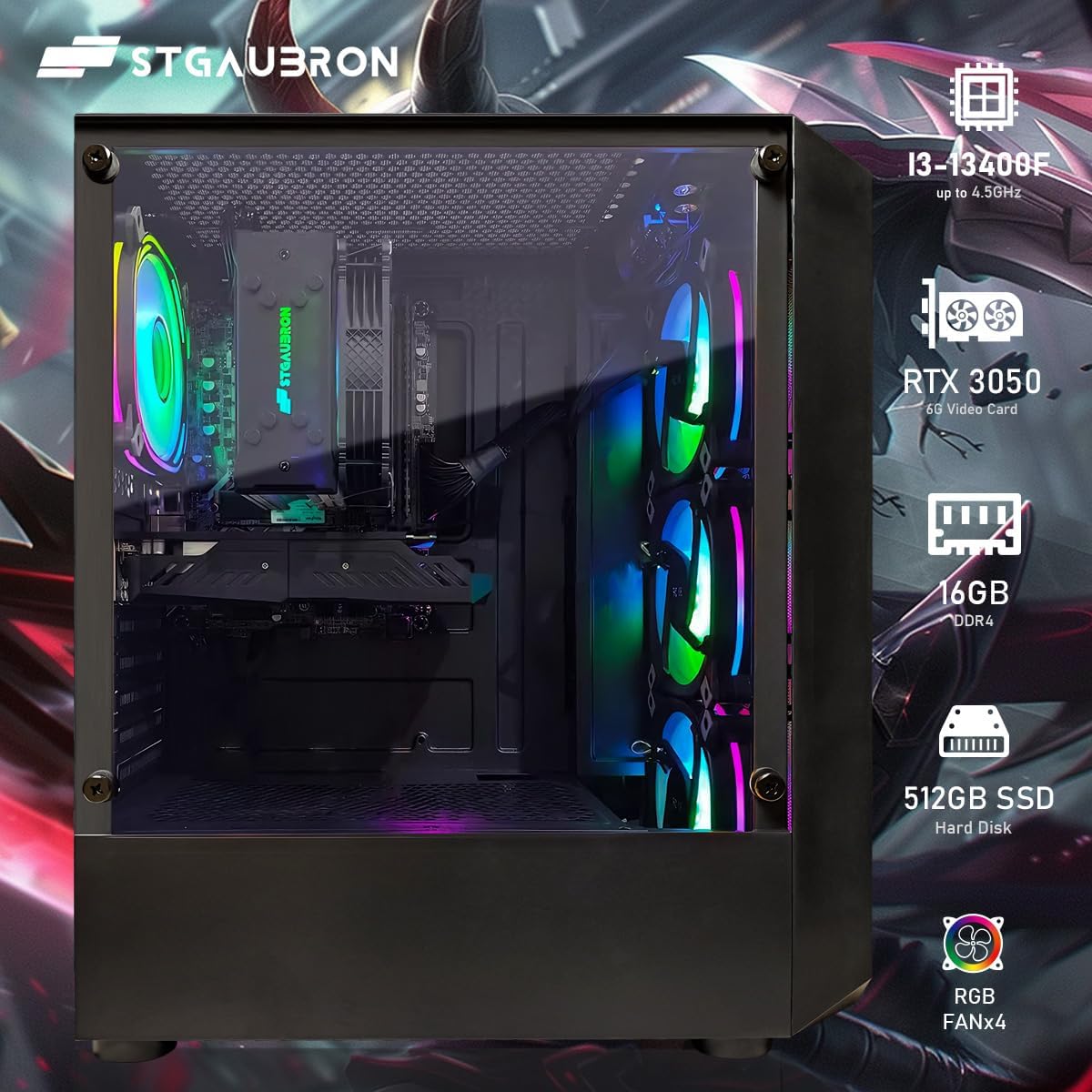
The system comes equipped with 16GB of DDR4 RAM. This is an intelligent, cost-effective choice for this build.
- Capacity (16GB): This is the current “sweet spot” for gaming. It is sufficient to run virtually all modern games without issue, while also providing enough headroom for multitasking (e.g., running Discord, a browser, and a game simultaneously).
- Type (DDR4): The 13th-gen Intel Core i5-13400F supports both DDR4 and DDR5 RAM. By opting for DDR4, the manufacturer has prioritized budget, as DDR4 motherboards and RAM kits are more affordable. While DDR5 would offer a slight performance uplift to the CPU, this benefit would be minimal in a system that is primarily GPU-bound by the RTX 3050 6G. This is a well-balanced compromise that allocates the budget effectively.
Storage: 512GB SSD
Storage is handled by a 512GB SSD. While the interface (SATA vs. NVMe) is not specified, it is almost certainly an NVMe drive in a modern build, offering fast data access.
- Performance: The use of an SSD is non-negotiable for a modern PC. It ensures that Windows 11 Home boots in seconds, applications launch instantaneously, and game loading screens are drastically reduced.
- Capacity (512GB): This is the system’s most significant practical limitation. After the Windows 11 installation and essential applications, the usable space will be closer to 400-450GB. A single large AAA game, such as Call of Duty or Baldur’s Gate 3, can consume over 100-150GB. This drive will fill up very quickly. Users should consider a 512GB SSD as a “boot drive” and plan to add a secondary 1TB or 2TB SATA SSD for their main game library, which is a simple and cost-effective future upgrade.
Build Features and Modern Connectivity
Cooling and Aesthetics: RGB Fan x4
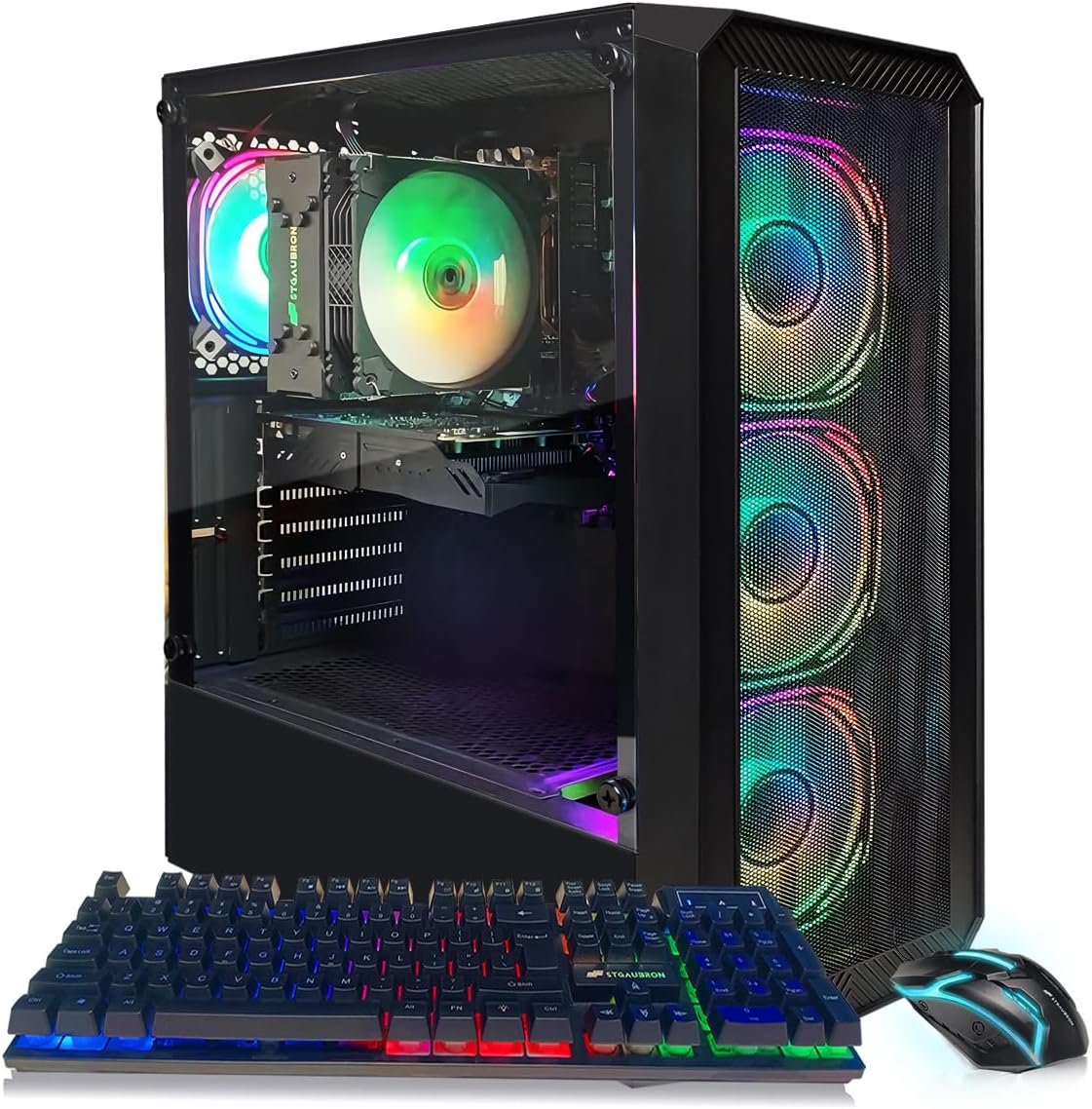
This STGAubron system includes four RGB fans. This is a strong feature for both aesthetics and performance. A standard configuration would involve three front-intake fans and one rear-exhaust fan. This “positive pressure” setup provides a steady flow of cool air over the CPU and GPU, ensuring that the components can maintain their maximum boost clocks during extended gaming sessions without thermal throttling. The RGB lighting adds a modern “gamer” aesthetic that is a key part of the prebuilt appeal.
Connectivity: WiFi 6 & Bluetooth 5.2
The inclusion of WiFi 6 (802.11ax) and Bluetooth 5.2 is an excellent, high-value feature.
- WiFi 6: This is a major upgrade over older WiFi 5 (802.11ac). It offers higher theoretical speeds, improved efficiency, and—most importantly for gamers—lower latency, especially in congested network environments with many devices. This provides a “like-Ethernet” experience for online gaming without the cable.
- Bluetooth 5.2: This ensures a stable, low-latency connection for modern wireless peripherals, such as controllers (Xbox, PlayStation), headsets, and mice.
Final Verdict: An Intelligent 1080p Streaming and Gaming Machine
The STGAubron Gaming PC, built around the Core i5-13400F and RTX 3050 6G, is a well-balanced and intelligently specified mid-range system.
Its greatest strength is the Intel Core i5-13400F processor. This 10-core, 16-thread CPU provides an exceptional performance foundation that will not be a bottleneck for years to come, making it a powerful productivity and multitasking machine in addition to its gaming prowess.
The GeForce RTX 3050 6G firmly defines this as a 1080p gaming rig. It is a capable card that, thanks to DLSS 2.0, can handle modern AAA titles at medium-to-high settings with a smooth 60 FPS. Its most valuable feature, however, is the NVENC encoder, which makes this an outstanding and affordable choice for aspiring streamers.
The package is rounded out by smart, cost-saving choices like 16GB of DDR4 RAM and essential modern features like WiFi 6 and a robust 4-fan cooling solution. The 512GB SSD is its only significant limitation, but this is an easily rectified one.
This STGAubron PC is an ideal choice for:
- First-Time PC Gamers: A perfect, all-in-one package for 1080p gaming.
- Aspiring Content Creators: A powerful entry-level streaming and video editing station thanks to the i5 CPU and NVENC encoder.
- Students and Multitaskers: A fast and responsive computer that can handle demanding academic or office work by day and modern gaming by night.