
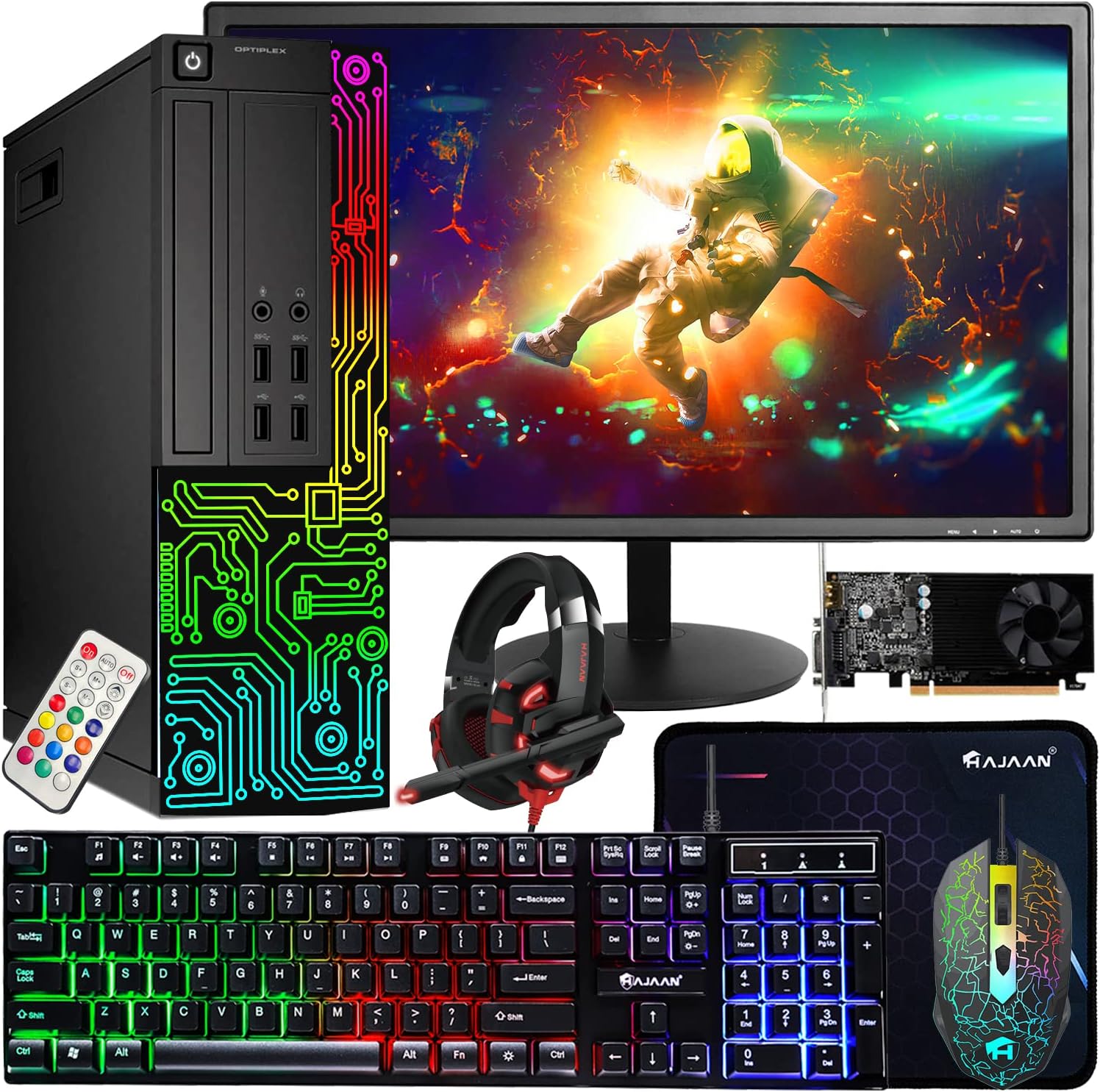


Dell Gaming OptiPlex (Renewed) Review: A Technical Analysis of a Repurposed PC
Introduction: Defining the “Renewed Gaming PC” Category
The pathway to PC gaming is diverse. While many opt for custom-built rigs or new prebuilt systems, a significant and growing market segment revolves around “renewed” or “refurbished” computers. This Renewed Dell Gaming OptiPlex Desktop is a prime example of this category. It takes a business-class machine—the Dell OptiPlex, a workhorse of the corporate world—and retrofits it with components and peripherals to create an accessible, all-in-one gaming package.
This review will provide a deep, technical analysis of this specific configuration. We will dissect the hardware, from its ambiguous (yet powerful) Intel Core i7 processor to its entry-level GeForce GT 1030 graphics card. The goal is to establish a clear, data-driven performance baseline for this machine, evaluating its capabilities for gaming, general productivity, and media consumption. This analysis will strictly adhere to the technical specifications and industry-standard performance metrics, without incorporating any subjective user opinions.
1. Understanding the Core Components: The OptiPlex Foundation
This machine is, at its heart, a refurbished Dell OptiPlex. This is a critical distinction from a ground-up gaming build. OptiPlex systems are engineered for reliability, longevity, and stability in office environments. This foundation brings both distinct advantages and tangible limitations to a gaming context.
The “Intel Core i7” Processor: A Variable Powerhouse
The most crucial, yet most variable, component in this listing is the Intel Core i7 processor. Unlike a new product with a precise model number (e.g., Core i7-14700F), a “renewed” OptiPlex can feature an i7 from one of many generations. Common refurbishing practices utilize CPUs from the 4th generation (e.g., i7-4770) up to the 8th or 9th generation (e.g., i7-8700).
Regardless of the specific generation, the “Core i7” designation ensures a high level of processing power.
- 4-Core, 8-Thread Models (e.g., i7-4770, i7-7700): These processors are still highly capable. With 4 physical cores and 8 logical threads, they deliver excellent performance in multitasking and productivity. Their strong single-core clock speeds are more than sufficient to handle the paired graphics card without creating a CPU bottleneck.
- 6-Core, 12-Thread Models (e.g., i7-8700): If the unit contains an 8th-gen or newer i7, its performance is substantially higher, offering a modern 6-core/12-thread layout. This provides a significant advantage in CPU-heavy games, streaming, and video editing, far exceeding the demands of the included GPU.
In either scenario, the processor is a high-performance component that anchors the system. It ensures that the operating system (Windows 11 Pro), web browsing, and productivity applications run with exceptional speed and responsiveness. For the gaming performance of this specific bundle, the CPU is, in all likelihood, more powerful than what the graphics card requires, which is a positive attribute.
System Memory: 16GB RAM
The system is equipped with 16GB of RAM. The type (DDR3 or DDR4) is dependent on the generation of the Core i7 processor.
- DDR3 (Common with 4th-Gen CPUs): Operates at lower frequencies (e.g., 1600MHz).
- DDR4 (Common with 6th-Gen and newer CPUs): Operates at higher frequencies (e.g., 2133MHz – 2666MHz).
For the performance profile of this machine, the distinction between DDR3 and DDR4 is largely academic. The 16GB capacity is the key takeaway. This amount is the modern standard for a comfortable computing experience. It is more than sufficient for:
- Running most games without memory-related stutters.
- Heavy multitasking, such as running dozens of browser tabs, office applications, and media players simultaneously.
- Entry-level content creation, like photo editing and 1080p video projects.
This generous RAM capacity complements the Core i7, ensuring the system’s processing power is not hindered by a lack of memory.
Storage: 512GB Solid State Drive (SSD)
A major contributor to the system’s responsiveness is its 512GB SSD. By using a solid-state drive instead of a traditional mechanical hard drive (HDD), the system benefits from an exponential increase in data access speeds.
This translates to tangible, everyday benefits:
- Rapid Boot Times: Windows 11 Pro will load from a cold start in seconds.
- Instant Application Launches: Programs open almost instantaneously.
- Faster Game Loading: Game levels and assets load significantly faster, reducing wait times.
The 512GB capacity provides a reasonable amount of space for the operating system, essential applications, and a selection of games. While perhaps not a high-end NVMe model, even a standard SATA SSD (common in OptiPlex builds) provides a transformative user experience compared to an HDD.
2. The Graphics Engine: A Technical Deep Dive on the GeForce GT 1030 2GB GDDR5
The component that defines this machine’s “gaming” capabilities is the NVIDIA GeForce GT 1030 2GB GDDR5. It is vital to have a technically accurate understanding of what this card is, what it was designed for, and what it can realistically execute.
Architecture and Specifications
The GT 1030 is based on NVIDIA’s “Pascal” architecture (GP108 chip), launched in 2017. It features 384 CUDA cores and a 64-bit memory bus.
The most critical specification in this product’s title is GDDR5. An alternative, much slower version of the GT 1030 exists which uses DDR4 memory. The presence of GDDR5 is a significant advantage, as its 48.06 GB/s of memory bandwidth is double that of the DDR4 version, leading to vastly superior performance in games.
This GPU is a low-profile, low-power card (30W TDP), meaning it draws all its power directly from the PCIe slot without needing an external power connector. This makes it the ideal and, in many cases, the only viable graphics upgrade for a proprietary, low-wattage power supply found in a Dell OptiPlex Small Form Factor (SFF) or Desktop (DT) chassis.
Real-World Gaming Performance Profile
The GT 1030 2GB GDDR5 was not designed to be a gaming powerhouse. It was designed as a modern display adapter for 4K media and a significant step up from integrated graphics. However, it is capable of running a specific class of games very well.
Target Performance: 1080p (1920×1080) at Low-to-Medium Settings
- Excellent for Esports Titles: This is the GT 1030’s sweet spot. Games that are highly optimized and less graphically demanding will run smoothly.
- Valorant: Can achieve 100+ FPS at 1080p on low settings.
- Counter-Strike 2 (CS2): Can maintain a playable 60+ FPS at 1080p on the lowest settings.
- League of Legends / Dota 2: Will run at high frame rates on medium to high settings.
- Rocket League: Capable of a stable 60 FPS at 1080p on “Performance” or “Quality” settings.
- Capable for Popular Indie & Older AAA Titles:
- Minecraft: Runs exceptionally well.
- Grand Theft Auto V (GTA V): Can achieve 50-60 FPS at 1080p on normal/medium settings.
- Fortnite: Playable, but will require “Performance Mode” (low-fidelity graphics) to maintain a stable 60+ FPS at 1080p.
- Not Suitable for Modern AAA Titles: This is where the card’s limitations are clear. The 2GB VRAM buffer and 384 CUDA cores are insufficient for graphically intensive games released in recent years.
- Cyberpunk 2077, Starfield, Alan Wake 2, Hogwarts Legacy: These games will either not run or will be unplayable (sub-30 FPS) even at the lowest possible 720p settings.
In summary, the GPU is a capable entry-point for the world’s most popular esports titles but is not intended for modern, high-fidelity, “AAA” gaming experiences.
3. The “Renewed” Factor: What Does It Mean?
The “Renewed” status is central to this product’s value. A renewed PC is not a “used” PC in the traditional sense. It is a device that has been professionally serviced, tested, and certified to be fully functional.
- Refurbishment Process: The Dell OptiPlex base unit was likely returned from a corporate lease. It has been inspected, cleaned, and any failing components (like an old HDD) have been replaced.
- New Components: Key components are often new. In this bundle, the GeForce GT 1030, the 512GB SSD, and the RGB peripherals (keyboard, mouse, headset, and chassis lighting) are almost certainly brand-new additions to the refurbished OptiPlex chassis.
- Testing: The entire system is tested for functionality, including the new Windows 11 Pro installation, before being packaged.
The result is a hybrid system: a durable, high-performance (i7) corporate-grade motherboard and CPU, combined with new entry-level gaming and storage components.
4. The Complete Bundle: Peripherals and OS
This product is not just a PC tower; it is an all-in-one battlestation.
- 24-Inch HDMI Monitor: The bundle includes a 24-inch monitor. In this price category, this is almost certainly a 1080p (1920×1080) resolution display with a 60Hz or 75Hz refresh rate. This resolution is the perfect match for the GT 1030’s performance target.
- RGB Keyboard, Mouse, and Headset: These are entry-level peripherals designed to provide a complete “gamer” aesthetic out of the box. The RGB lighting is a cosmetic feature, and the components themselves provide the basic functionality needed to start playing immediately.
- WiFi: Connectivity is typically provided via an included USB WiFi adapter, allowing for wireless internet access without needing an Ethernet cable.
- Windows 11 Pro: The inclusion of a professional, licensed version of Windows 11 Pro adds significant value. It ensures the user has a modern, secure, and feature-rich operating system without the extra cost or hassle of installation.
Conclusion: A Technical Verdict
The Renewed Dell Gaming OptiPlex Desktop is a masterclass in strategic component matching. It leverages the high value and robust build quality of a refurbished corporate PC—powered by a still-potent Intel Core i7 processor—and addresses its weaknesses by adding a fast 512GB SSD, a sufficient 16GB of RAM, and a dedicated graphics card.
The GeForce GT 1030 2GB GDDR5 is the defining component for its gaming identity. It is a deliberate and intelligent choice for this build, as its low power draw makes it compatible with the OptiPlex’s proprietary power supply. Its performance is perfectly aligned with a 1080p/60Hz monitor for the world’s most popular esports titles (Valorant, CS2, League of Legends) and a large library of older AAA games.
This system is not, and does not pretend to be, a high-end rig for running modern AAA games at ultra settings. Instead, it is a comprehensive, all-in-one package meticulously engineered to provide a responsive, enjoyable, and aesthetically complete gaming experience for a specific and massive market: the new or budget-conscious player focused on the most popular competitive titles. It is a highly capable productivity machine by day and a dedicated esports station by night.